Showing posts with label Sensorial. Show all posts

Sunday, July 12, 2020

Summer Enrichment 2: Let's Explore Outdoors!

The Outdoors have limitless opportunities for learning and exploring!


Morning Connection Videos:

Monday - This week we're introducing learning activities to take outdoors - sorting & classifying skills, sink or float experiment, a twist on an active vocab game, and a poem - A house is a house for me

Tuesday - For the months of the year song, ignore my motions and raise your arms for this month! A house is a house for me poem, A beginning sounds game (can also be done with rhyming words, ending, or middle vowel sounds), and making patterns.

WednesdayToday we introduce "3 words" rhyming game, review finger spelling, and sing the number writing song. Remember that these kinds of language games are one of the best ways you can prepare your child succeed with writing and reading skills.

ThursdayToday we'll sing the seasons song (make sure your child knows it's summer now!!), compare two flowers - dandelion and daffodil, and introduce some sequencing activities. 
What flowers can you find outside now that it is summertime?

FridayHappy Friday! Today we're singing "Days of the Week" in English and Spanish, and a tossing game with socks that also practices position words ("inside" and "outside") and partitioning 5.

A few outdoor activity ideas:

Sweeping a porch, patio, or sidewalk is fun and great exercise

Sink or Float - Find 6-10 objects outside, make a hypothesis on if they will sink or float, use a bowl of water to find out!

Fun with rocks - collect a few rocks outside, scrub them clean. Draw or paint on one! How many can you stack?

Flowers - How many different kinds of flowers do you see outside? Learn the names of 3. How do they smell?

Paint with Water - Have an old paintbrush? Dip it in a container of water and "paint" outdoors!

Patterns with Nature - collect objects outside (rocks, leaves, sticks, petals, etc) and use them to practice making patterns (how-to video), or try making more elaborate designs (examples)

Outdoor writing - Write with a stick in the dirt, or use sidewalk chalk (or a brick or rock!)

Other math and language resources and ideas on our Montessori at Home page

Saturday, March 28, 2020

Sorting & Sequencing Activities for home

You can help your child practice skills of sorting into categories, matching like things, making patterns, and putting items in order without any specialized materials. These activities can be done with items in your house or things you find outside.
You can go for a walk (or likely just step a few feet outside) to gather some sticks, leaves, stones, flowers, etc. for these activities.

Matching and Sorting into categories 

a collection of leaves, ready for pairing
matching leaves

matching leaves to their leaf rubbing (also an art option!)
Sorting objects into groups (also called "classifying") begins with simple tasks for 2-3 years old (ex: spoons vs. forks; cars or stuffed animals, sticks or leaves), and can be made increasingly more challenging as the child grows through their school years.  Objects can be classified (sorted) by: size, shape, color, type, or other characteristics. Some ideas for categories:
- flowers, sticks, and leaves (sorting by type)
- types of coins (give them a handful of change to sort)
- types of beans/grains 
It's great to take the same objects and see if your child can come up with more than one way to sort them. Some items can also be sorted with eyes closed or a blindfold to increase the challenge! 

Comparing and sequencing

Children can compare two objects by different characteristics - which stick is longer? Which leaf is a darker green? Which object is heavier? 
The next level of challenge is to put a group of objects in order. Examples - biggest to smallest, longest to shortest, darkest to lightest shade of a color, heaviest to lightest, roughest to smoothest. Here's some samples: 

Comparing - which is heavier?


Objects sequenced from heaviest to lightest

Objects collected by a child to sequence by length


Sequencing - putting sticks in order from longest to shortest


Patterns

Another form of sequencing is to create patterns. You can do this with anything around the house - legos, hair barrettes, dry beans, cereal, spoons & forks, etc. It also works great with things you find outdoors - different kinds of sticks, leaves, stones, flowers, etc.

A simple alternating pattern
A more complicated pattern


Wednesday, March 21, 2018

Sensorial Curriculum - Visual Perception

In the Sensorial curriculum of a Montessori classroom, we develop children's perceptiveness with each of their senses. Our goal is to increase their awareness of what they perceive through their senses and help them develop a mental framework for organizing and understanding these perceptions. The Sensorial curriculum provides a cognitive foundation for math and science.

Within the Sensorial curriculum, we have materials and activities to cultivate each of the senses. This post will only include the Visual perception materials - more to come later!

Size

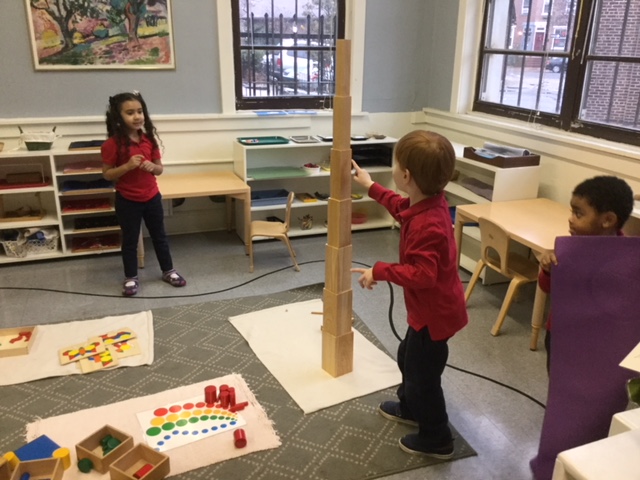
Cylinder blocks (or knobbed cylinders) - each of the 4 blocks contains 10 cylinders that vary by different dimensions. A child begins working with one block at a time and progresses to being able to do all four blocks (40 cylinders) together.
The cylinder blocks are an example of a self-correcting Montessori material - the child can tell if there is an error because not all the cylinders will fit in!
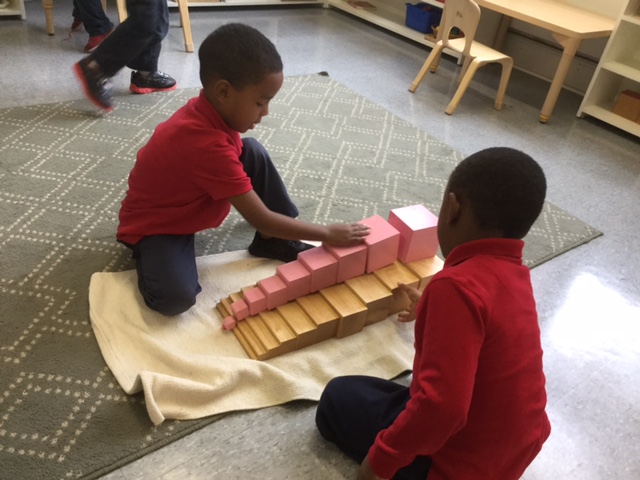
 Most children are not able to see the small differences between the ten cubes of the Pink Tower when they are first introduced to it. Through repetition and exploration, they gradually become aware and learn to sequence the cubes by size - and feel very proud when they do! The opportunity to develop problem-solving skills is built into all these materials. A child may visually notice that they have a piece out of order, but it is additional challenge to figure out how to fix it. 

The Brown Stair (or Broad Stairs) provides the next level of challenge - the prisms vary in two dimensions instead of all three. After a child can sequence the brown stairs, they enjoy rolling a small wood marble down the steps, hearing the pitch change as it descends.  


The Red Rods come next - 10 rods ranging from 10cm to 1m.

There are additional activities that the children can do with each of these materials, alone or in combination.

A few examples of the many possibilities:


This child has built the Pink Tower with two sides flush,  creating a 1cm ledge on each level. The smallest (1cm) cube can be carefully slid along the step on each cube. 


Color


The first color box has only the three primary colors (red, yellow, blue), with two tablets of each color. Color box II adds secondary colors (orange, green, purple) as well as pink, brown, black, gray, and white.


After matching the color tablets, a child can walk around the room with a basket, looing for an object that is the same color as one of the tablet pairs. They bring the object back to the mat, then go in search of another color. This activity expands their conceptualization of color and exercised their working memory. (The tablets stay on the mat, which adds the challenge of needing to store the color in their mind as they go around the room.)


The Box of 32 pairs provides an increased challenge - matching pairs in four shades of each color. When we introduce the material, we take just one color out of the box at a time and match the four pairs before moving onto the next color. This child has chosen a different approach. She is purposefully engaged so we observe with interest to see what we can learn about her thought process and do not intervene or disrupt her focus.

Color Box 3 has seven shades of each color that can be graded from darkest to lightest

Shape

Children learn the names and forms of geometric shapes with the Geometry Cabinet